

Back To Basics: Deep Dive Part 8
Viva the User
Building a user centric business and system process / solution.
Doing software analysis without a clear understanding and reflection of the user’s role in business and system processes is not good enough. - Henkie Maritz
A very important principle that will significantly help your analysis is to focus on the people involved within the process.
Consider the following points:
It’s the people (users) who makes a process work
I have seen the same software installed at multiple businesses. The one business runs like clockwork – the financial, attendance and account data are perfectly up to date, and customers are happy. Another similar business (exact same software) is a mess – with duplicate transactions, outdated data and frustrated customers.
The bottom line is that it’s people (the users of your system) who make it work.
Consider the users when designing a new business and system process
You need to focus on the people who use and will use the system. Focus means not just to understand their skill level and what they do outside the current system but also tailoring the new solutions to make their lives easier, simpler and prone to fewer mistakes.
The user is not an afterthought. It is a key consideration. Designing a solution that is so complicated that only a highly skilled user is needed is maybe not that great idea.
KISS (Keep It Super Simple)
People like me, who started working before mobile phone apps, would agree that the arrival of smartphone apps challenged our thinking to inspire simplicity. Corporate enterprise apps are however more complicated by nature and cannot be directly compared with simple mobile apps. The principle remains – design a simple user solution.
Consider the following design illustration. I did not come up with this, I saw it somewhere and found it to be very true over the years.
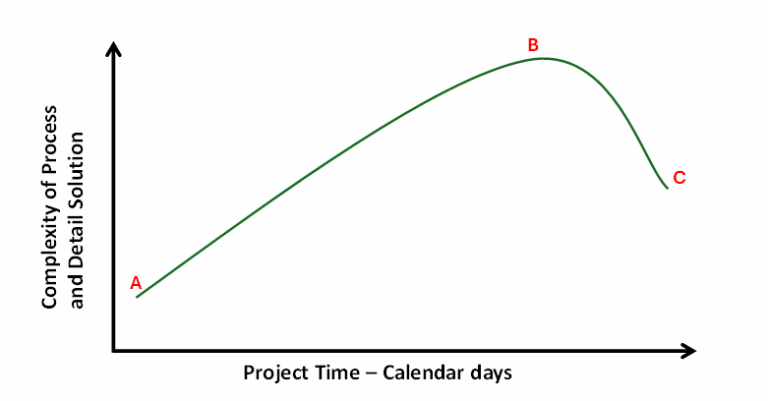
As you begin designing your new process (business and system), user roles, screens, integrations, business rules, etc. it starts off as simple (point A).
Over time, as you work through the hundreds of thousands of use cases and exceptions, complications start to mount to the point of reaching a very complex solution (point B).
You will be tempted to stop here since you feel you’ve now considered everything, and time is not on your side anymore.
Point C is achieved when you refuse to release a too complicated solution. Most complex solutions can be made simpler if working through the details and searching for improved, simpler and efficient ways.
Golden rule: Keep going until it becomes simpler.
In closing this principle, remember this acid test to verify your user-friendly process and system design:
Will you enjoy working on the system if you are the user, or will you hate it?
You can download the whitepaper from https://jalia.co.za/services/
Author: Henk Maritz (jalia.co.za)
© 2025 Jalia Technologies (Pty) Ltd – jalia.co.za. All rights reserved.
No part of this publication may be copied or used in any form without prior written permission from the author.